How to Choose a Branding Agency: 8 Questions To Ask
.webp)
The right branding agency is one that treats strategy as its primary product, not design.
Of the thousands of agencies operating in the UK, professional services firms that invest in brand strategy alongside design outperform lower-investing peers by up to 30% in profitability, according to the Hinge 2025 High Growth Study, which tracked 770 firms representing more than £87 billion in combined revenue. The difference between a productive rebrand and an expensive exercise that restarts two years later comes down to the questions asked before any brief is signed.
Not sure where your current brand sits? Huddle Creative's Blandscape audit is a free one-page scorecard covering ten brand areas including positioning, visual identity, tone of voice, website UX, and trust signals. It takes one working week to receive and gives a starting point before any agency conversation begins.
This article gives you 8 specific questions to put to any branding agency you shortlist, with particular attention to what law firms, finance businesses, and property companies need to probe for before making any solid decisions or investments.
We’re ready to answer your questions. Brief us today
Why the Questions You Ask Define the Outcome You Get
A branding brief shapes how an agency works, but the questions asked during the selection process reveal how an agency thinks. Agencies that lead with portfolio aesthetics before understanding your market position are signalling that design is their primary output. Agencies that respond to your brief with further questions about positioning, competitive landscape, and internal stakeholder complexity are signalling that strategy is.
According to McKinsey's Business Value of Design study, which tracked 300 publicly listed companies over five years across consumer goods, banking, medical devices, and retail, top-quartile design performers grew revenues and shareholder returns at roughly twice the industry-average rate. The common factor was not the quality of the visual output. It was the degree to which brand thinking was integrated into business decisions at a strategic level.
The 8 questions below help you identify whether an agency operates at that level.
8 Questions to Ask a Branding Agency Before You Commit
Question 1: Does your agency understand the reputational and regulatory context of our sector?
A branding agency working with professional services firms must understand that trust is the product, not merely a marketing asset. For a law firm, a finance company, or a property advisory business, brand credibility connects directly to client retention, referral rates, and fee levels. The constraints on communications are different from consumer markets, and an agency without sector knowledge mistakes freedom for rigour.
Financial services firms operate under FCA guidelines that govern how claims about performance and expertise are communicated. Property developers selling off-plan schemes face specific trust barriers that require a brand to convey permanence and credibility before a single unit completes. Law firms work in a sector where conservative risk tolerance sits alongside a genuine need to stand out from competitors who all use the same language about expertise and client care.
Ask the agency to describe the specific constraints they have worked within for clients in your sector. A credible answer names those constraints and explains how the brand strategy addressed them. A vague answer about "understanding your audience" is not sufficient.
The scale of the challenge for law firms specifically: 96% of people seeking legal advice begin their research with a search engine, and 98% read online reviews before hiring. Every touchpoint of a law firm's visual and verbal identity contributes to those first impressions. An agency without legal sector experience is unlikely to understand how to balance authority with approachability within those constraints.
When Huddle Creative rebranded Harbottle and Lewis, a law firm established in the 1950s serving the creative industries, the brief required preserving legacy credibility while projecting contemporary relevance. The resulting brand positioned the firm as a trusted adviser in high-stakes industries, bridging a pioneering heritage with modern leadership.
That level of nuance requires sector understanding, not just visual skill.
Question 2: How does your strategy process work before design begins?
A branding agency's strategy phase accounts for at least 40% of the total project timeline when the work is done properly. Strategy is the diagnostic phase: it defines where the brand sits in the market, what the firm genuinely stands for, where competitors are positioning themselves, and where the gaps in perception exist. Design translates that strategy into a visual and verbal language. If an agency presents design concepts within the first two weeks of engagement, it has skipped the diagnosis.
Ask the agency to walk you through a recent project timeline, showing where strategy ended and where design began. Ask what tools they use to interrogate competitive positioning and what format the strategy output takes before any creative brief is written.
The Edelman-LinkedIn B2B Thought Leadership Impact Report found that 73% of B2B decision-makers consider an organisation's thought leadership a more trustworthy indicator of its capabilities than its marketing materials. That trust is built through the positioning story developed in the strategy phase. No amount of visual sophistication compensates for a brand that cannot articulate a clear, differentiated point of view.
Huddle Creative's Clarity x Collaboration methodology places stakeholder interviews, competitive auditing, and a positioning workshop before any design brief is written. That approach is evident in the outcome for Daniel Watney, a London property advisory firm with 165 years of history. The core finding from the strategy phase was that the firm's reputation resided in individual partner relationships rather than in the brand itself.
Repositioning around a partnership model, grounded in stakeholder research, gave the firm a shared strategic language before a single visual was produced.
Question 3: Can you show us case studies of firms at our stage and scale?
Portfolio breadth is less useful than portfolio relevance to your specific challenge. Any agency can show impressive visual work across diverse industries. What reveals whether an agency is right for your business is whether they have solved the specific problem you are facing: a legacy brand that no longer reflects current positioning, a gap against newer competitors, a multi-service firm whose brand does not communicate the full breadth of its expertise, or a merger that has created identity confusion.
Ask for two or three case studies that match your situation in terms of sector, business size, and the nature of the brand challenge. Then ask what the specific brief was, what the strategic approach was, and what the measurable outcome was.
The challenges differ by sector in specific ways. For law firms, the problem is frequently differentiation in a market where most firms use the same three adjectives. Huddle's dedicated guide to branding agencies for law firms outlines what a sector-ready agency needs to demonstrate.
For finance businesses, it is often about communicating trust and competence simultaneously to B2B audiences who are highly sensitive to credibility signals; 69% of consumers recognise fintech brands compared to 59% awareness of traditional bank digital offerings, according to eMarketer, demonstrating that brand investment produces measurable recognition advantages even in regulated sectors.
Huddle's guide to branding agencies for finance firms covers those specific requirements in detail. For property companies, the challenge is often about justifying premium pricing through brand perception before a physical product exists; Huddle's guide to property branding agencies maps the landscape for developers and advisories.
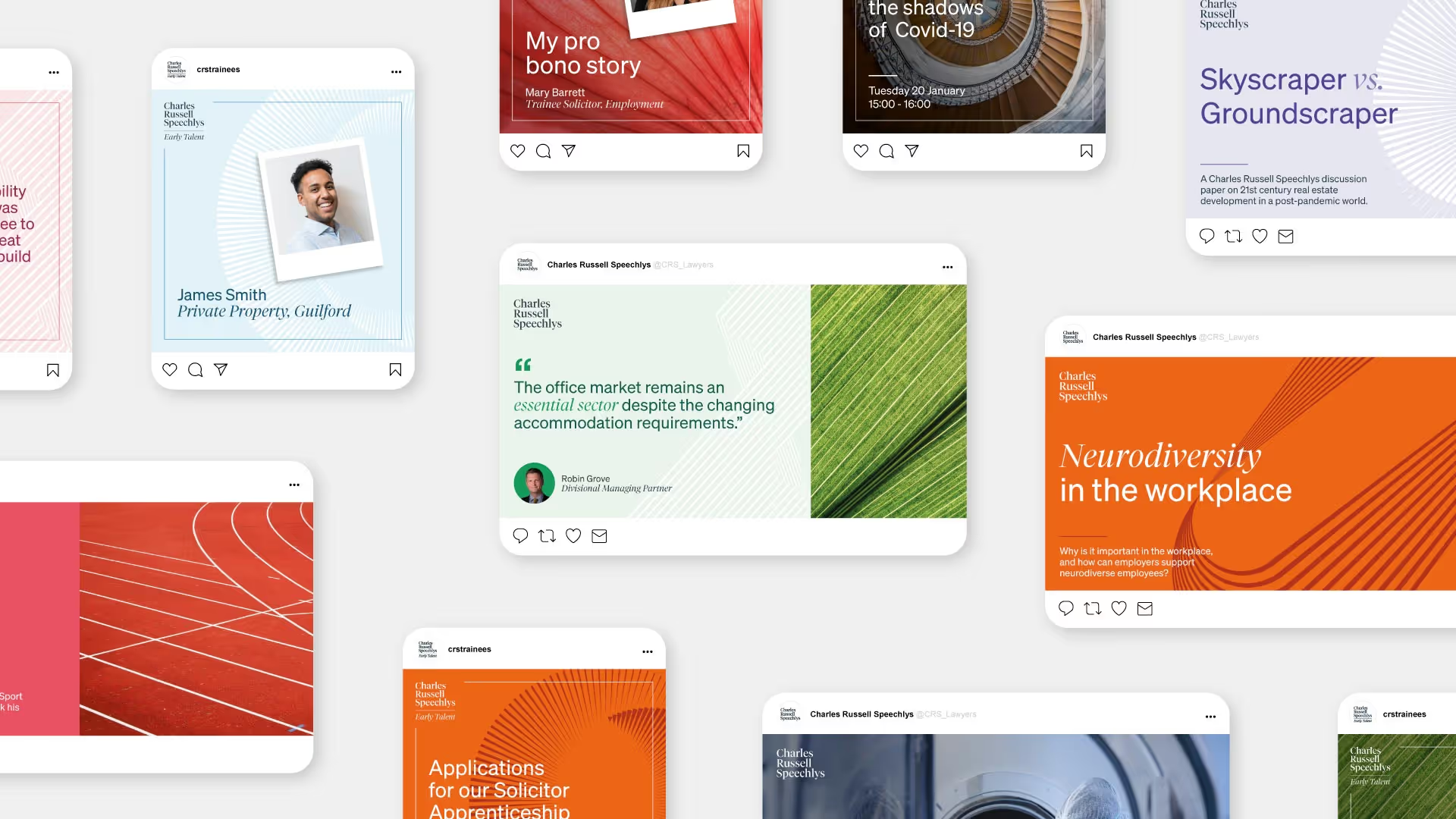
Huddle Creative's work for Charles Russell Speechlys, a full-service international law firm, addressed a rebrand that needed to reflect a merger while articulating a forward-facing identity. The work for Brasier Freeth, commercial property specialists and chartered surveyors, tackled a firm whose brand was underselling its market strength. As their Director of Marketing noted after the project: the new brand enabled the firm to approach new business opportunities with greater confidence.
Those are different briefs requiring different strategic approaches. An agency that articulates why those approaches differed is one that thinks, not one that templates.
Question 4: How do you handle complex internal stakeholder environments?
Professional services rebrands fail more often because of internal stakeholder disagreement than because of weak creative work. A partnership structure at a law firm, a board with divided opinions on brand direction at a finance business, or a property developer with multiple regional directors all create the same risk: a brief agreed in the first meeting becomes unrecognisable by the time the design is reviewed.
Ask the agency how they manage stakeholder sign-off across a project. A credible answer includes a structured workshop process in the strategy phase that surfaces disagreements before design begins, a defined decision-making hierarchy agreed at the outset, and a staged presentation process that reduces the risk of large-scale reversals late in the project.
Research from the Ehrenberg-Bass Institute, cited by LinkedIn's B2B Institute, found that major professional services purchasing decisions involve between 9 and 12 stakeholders. A branding decision within a professional services firm mirrors that complexity internally. An agency without a structured stakeholder management process finds itself reworking final concepts because a senior partner or board member who was absent from the first workshop disagrees with the strategic direction.
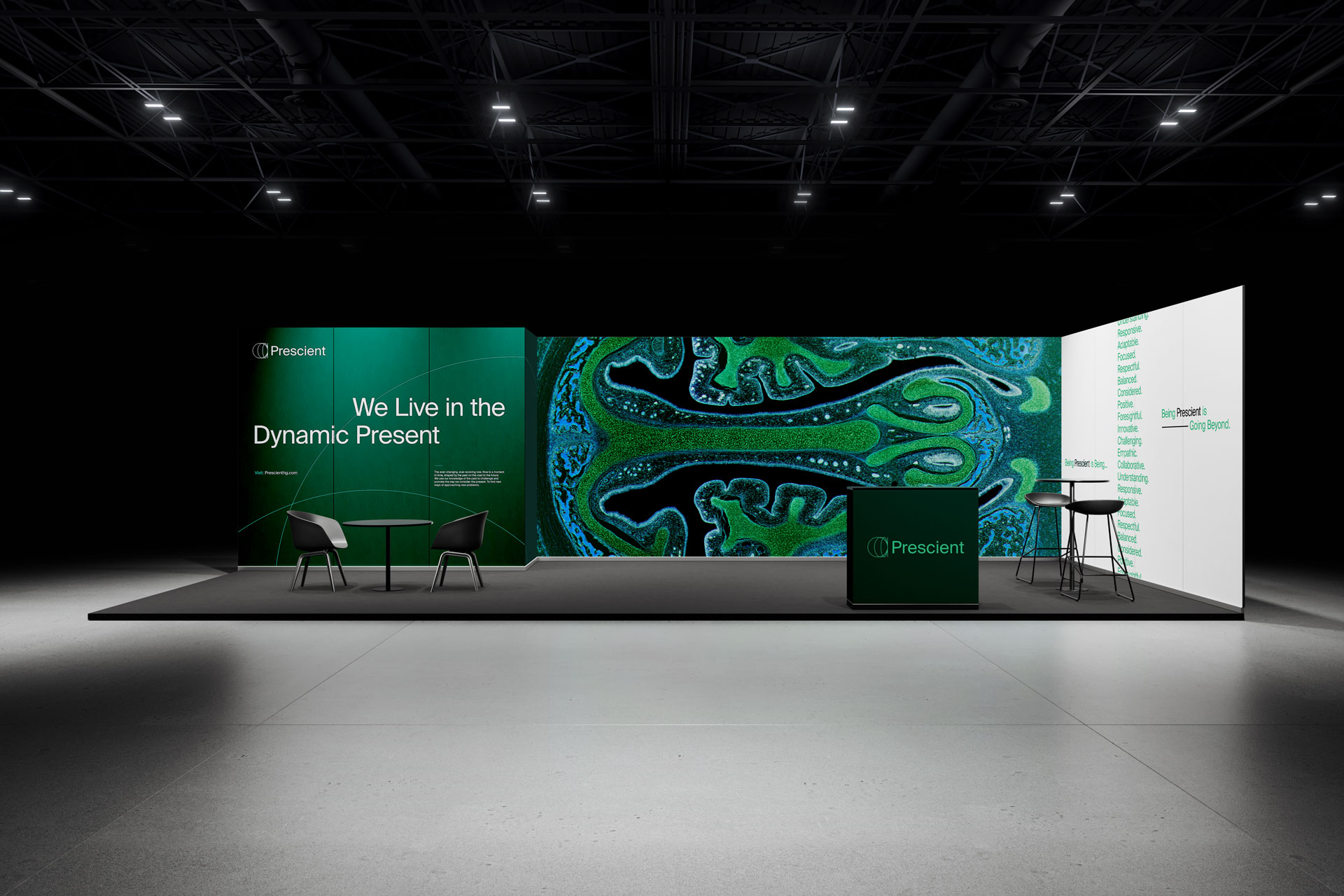
What this looks like in practice: when Huddle Creative rebranded Prescient, a global healthcare consultancy that had grown through acquisition, the project required active stakeholder participation across offices in India, the US, and Europe simultaneously.
Our agency ran collaborative workshops, remote sessions, and staged presentations across all three regions to ensure that every leadership group shaped the strategic direction before a single design decision was made. That level of process rigour is what prevents a final-stage rejection from a stakeholder who never saw the earlier thinking.
Question 5: What does brand governance and support look like after the project ends?
Brand guidelines alone do not maintain a brand. A branding project that ends with the delivery of a PDF guidelines document typically results in inconsistent application within six months. The agency that built the brand is no longer involved, the internal team applies it without oversight, and the brand fragments across channels and materials.
Ask the agency whether they offer ongoing brand support, what that looks like in practice, and how they have structured it for previous clients. Strong answers describe a retained support model with defined review cycles and clear processes for handling new brand applications as the business grows, whether that is a new service line, a new office, or a digital product launch.
Marq's State of Brand Consistency Report, which surveyed more than 400 brand and marketing professionals, found that 68% of organisations say brand consistency has contributed at least 10% to revenue growth, and 33% report it boosts revenue by 20% or more. The same research found that only 30% of companies have brand guidelines that are widely recognised and followed throughout the organisation. That gap between what guidelines say and what teams actually do is precisely what ongoing brand support addresses.
For a professional services firm competing on credibility, inconsistency in brand application directly erodes the trust a rebrand was designed to build. A law firm whose pitch documents look different from its website, or a property developer whose site hoardings carry a different tone from its digital advertising, is communicating fragmentation to the very audience it is trying to impress.
Huddle Creative structures a brand support offering as a distinct service line covering brand management, guidelines evolution, and ongoing creative production. That structure reflects how brands actually work after launch: they require ongoing decisions, adaptations for new markets or services, and periodic reviews as the business evolves.
Question 6: Do you offer naming, and how do you approach brand architecture?
Naming is the most underestimated element in a professional services rebrand. A firm that has grown through acquisition, that carries partner names in its brand, or that is entering a new market often faces a naming decision before it addresses identity. An agency without a structured naming capability defaults to repositioning around the existing name, which is not always the right answer.
Ask the agency whether naming is a separate service with a defined process, or whether it is something handled informally. A credible naming process includes linguistic checks across target markets, trademark feasibility screening, and domain availability assessment alongside the strategic rationale. It produces ownable, meaningful names, not a brainstorm shortlist.
Brand architecture is the related question: how do sub-brands, practice areas, or regional offices relate to the parent brand? For a law firm with multiple practice divisions, a financial services group with distinct consumer and institutional arms, or a property developer with several residential schemes under different names, getting architecture right defines how the brand scales without losing coherence. An agency without a view on architecture leaves that decision to the client, which typically produces an inconsistent brand family over time.
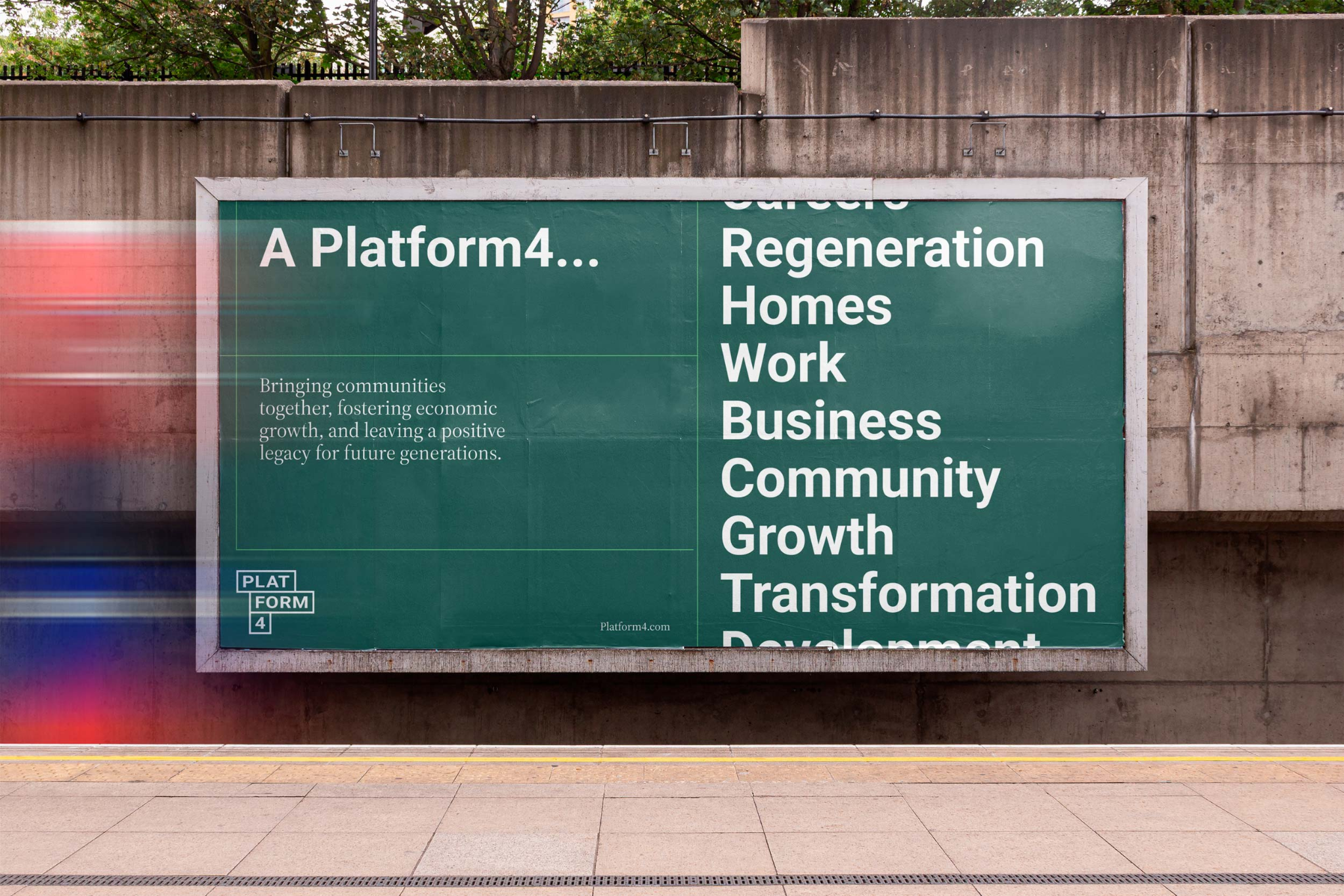
When Huddle Creative worked with Platform4, a brand positioned at the intersection of rail infrastructure and urban regeneration, the naming and architecture work preceded any identity development. That sequence, name first, architecture second, identity third, reflects how a coherent brand system is actually built rather than retrofitted.
Question 7: How do you define and measure a successful rebrand?
An agency that cannot define success in measurable terms is asking you to trust intuition over evidence. The honest answer is that some outcomes, particularly internal cultural alignment, are difficult to quantify in the short term. But there are measurable proxies that matter: pitch win rates, new business conversion, website engagement, staff retention, and the quality of inbound enquiries.
Ask the agency what metrics they tracked for a previous client rebrand and what changed. Ask how long after delivery they measured those outcomes. Ask whether they conduct post-project reviews to assess whether the strategic positioning held.
Example metrics could include:
- Shares: The Design Council's Design Index, which tracked 61 design-led UK companies including Barclays, Marks and Spencer, and Unilever, found that their shares outperformed the FTSE 100 by more than 200% over a decade. The index rose more in good times and fell less in bad times, and the outperformance held consistently across the measurement period.
- Growth + Profit: More immediately, the Hinge 2025 High Growth Study found that high-growth professional services firms grew four times faster and were up to 30% more profitable than lower-performing peers, with brand clarity as a consistent differentiator.
- Credibility: For property firms specifically, Edelman's trust research found that 88% of consumers consider trust an important factor when choosing which brands to buy from. For off-plan residential developments, where buyers commit significant capital before the product is built, brand credibility is the primary purchase risk mitigator rather than a secondary marketing consideration.
- Lead Quality + Quantity: Measuring enquiry quality and conversion rates before and after a rebrand also gives a direct read on whether the brand is working commercially.
Question 8: What is your collaboration model and how long does a full rebrand take?
A full brand strategy and identity project for a professional services firm in the UK typically takes between four and nine months, with the strategy phase accounting for the first two to three months of that. A timeline shorter than four months for a complex B2B rebrand is a signal that either the strategy phase is being compressed or the project scope is narrower than a full brand overhaul.
Ask the agency to outline a typical project timeline with clear phase divisions. Ask who your day-to-day contact will be and how decisions are escalated. Ask how many projects run simultaneously at the agency and whether you will have dedicated account management.
The collaboration model matters because professional services rebrands require the client to contribute substantial internal time: stakeholder interviews, workshops, content gathering, and review cycles. An agency that underestimates client-side involvement creates timeline slippage. An agency that overestimates it creates stakeholder fatigue. The strongest agencies are explicit about what they need from the client and when, before the contract is signed.
Multi-geography and post-acquisition projects extend those timelines further. The Prescient rebrand required coordinating stakeholder workshops across three continents, which added both time and structure to the process. That additional complexity is legitimate and produces a better-grounded strategy, but it needs to be built into the project plan from the outset rather than discovered midway through.
What Makes a Branding Agency the Right Fit for Professional Services?
Professional services firms, whether law firms, finance businesses, or property advisories, share a specific brand challenge: the product is intangible and the primary trust signal is reputation rather than a physical object. That means brand strategy in these sectors is inseparable from positioning strategy, and positioning strategy requires genuine sector knowledge.
The agencies best equipped for professional services work have rebranded firms where decision-making was distributed across a partnership or board, where regulatory context created real constraints on claims and messaging, and where the brief was ultimately about communicating a differentiated capability in a sector where most competitors claim the same things.
Huddle Creative has worked across law, finance, and property specifically because those sectors share a structural challenge: strong underlying businesses whose brands are not communicating their actual market strength.
Our work for Harbottle and Lewis, Daniel Watney, and Brasier Freeth each began with the same diagnostic finding: the problem was not capability, it was clarity. Arriving at that finding before any creative brief is written is what a strategy-first agency does differently from a design-first agency.
Is a Sector Specialist Agency Better Than a Generalist?
A sector specialist agency reduces the time spent briefing the agency on your market, but the more important distinction is whether the agency is strategy-first or design-first. A generalist agency with a rigorous strategy process and demonstrable experience in complex B2B environments produces better results than a sector specialist that moves to visual concepts before understanding the positioning problem.
The practical test is the same 8 questions above. An agency that answers them with specificity and draws on named examples from its own work demonstrates strategic maturity. An agency that pivots to showing portfolio visuals before addressing the strategic questions is telling you what it prioritises.
For law firms, the regulatory sensitivity of claims and the importance of partner buy-in make stakeholder management capability non-negotiable. For finance businesses, the FCA environment means brand claims need to be both credible and compliant. For property developers, the gap between brand perception and on-the-ground reality is the primary reputational risk. Each of those contexts requires specific knowledge, not just good design.
Huddle Branding Agency: Answering all your questions upfront
The 8 questions in this article are a filter for identifying whether an agency can deliver return, or whether they deliver a set of attractive assets that fail to move the commercial needle.
If you want a structured starting point before any agency conversation, Huddle Creative's Blandscape audit gives you a free, personalised read on where your brand currently sits across ten dimensions, including the positioning, trust, and consistency factors that professional services clients care about most.
Got a project in mind? Brief us today
FAQs
What distinguishes a full service branding agency from a standard marketing agency?
Full service branding agencies cover strategy, naming, brand identity, and ongoing governance, whereas a standard marketing agency typically focuses on executional marketing efforts such as campaign delivery, paid media, or content production. The right agency for a professional services firm is one whose agency's capabilities extend into strategic thinking about market positioning and competitive differentiation before any design work begins. The best branding agency treats brand positioning as a business problem first and a creative brief second.
How do you identify the perfect branding agency for a law, finance, or property firm?
The perfect branding partner for a professional services firm is one that demonstrates genuine sector knowledge alongside rigorous process, ask any shortlisted agency team to walk you through a real project timeline showing where strategy ended and where design began. A branding and digital agency that pivots immediately to portfolio visuals, rather than asking about your competitive landscape and stakeholder complexity, is signalling that creative output leads its thinking rather than strategic thinking.
How should marketing teams measure success after a rebrand?
Marketing teams often struggle to measure success because brand outcomes take time to fully manifest, but there are concrete proxies worth tracking from launch: pitch win rates, new business conversion, inbound enquiry quality, and website engagement. A credible agency partner should define those metrics before the project begins and conduct a post-launch review; an agency team that delivers assets without an evaluation framework is leaving the most commercially important question unanswered.